Ameek Kaur - Manager Passenger Transport Policy, Department of State Growth TAS

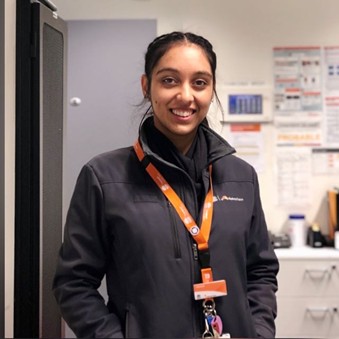
This month, we caught up with Ameek Kaur, Manager of Passenger Transport Policy, based in Tasmania. In her role, Ameek helps shape how people move across the state’s buses, ferries and taxi networks. She works across strategy, policy, change management and project delivery. With a background in psychology, Ameek’s career in transport has taken a few interesting turns, from a frontline role at Sydney Trains to human factors consulting - a niche field that looks at how people interact with complex systems.
She spoke with us about her pathway into transport, her move from Sydney to Tasmania, and why she believes transport is, at its heart, a people business.
Thank you for your time today. Tell us a bit about your current role?
I'm currently the Manager of Passenger Transport Policy at the Department of State Growth in Tasmania. My role sits at the intersection of policy, strategy and delivery. Passenger transport in Tasmania also has a very broad remit across buses, ferries and taxis.
How did you get into your current position?
My career in Transport has been quite broad. I've worked across the breadth of the Transport ecosystem. My career started in frontline operations as a customer service attendant on the Sydney trains rail network. Then I moved across to human factors, a specialised field, where I was providing advice within Transport for NSW and after that, as a consultant where I also worked on other projects including major transport and transport infrastructure across the country. I was driven to expand my knowledge and exposure, so I pursued opportunities across transport and landed my current position in strategy and policy. I currently work on developing and implementing statewide transport initiatives.
When you say ‘human factors’, what does that mean?
Human Factors is a scientific discipline which looks at how humans interact with the elements of a system and its environment. In this case, that's the transport ecosystem. The aim is to improve how people understand and interact with all parts of a transport system. It's a very niche discipline.
What are some of the milestones that have gotten you to where you are today?
One life milestone is education. I started my education with a Bachelor of Psychology Honours and at the time I was working at Sydney Trains. At the start, I couldn’t see the fit between how I could take my psych degree into a Transport career. Then, as part of my psych degree, I had to do a placement, which I did with the Sydney Trains Human Factors team and that opened a world of opportunities in terms of how I could integrate psychology and the design of transport systems. Recently, I started my MBA and that's prompted me to focus more on strategy and policy roles and look at systems at a higher and more holistically.
Some personal milestones include making the move from Sydney to Tasmania driven by a desire to broaden my experience and transition to a broader field. Being here has given me an incredible opportunity to work on statewide transport projects. I think it is a huge career step up. Tasmania is an amazing place to work in. The Transport department is smaller in comparison to NSW but offers the opportunity to work on a huge breadth of projects and initiatives. Here, you work with multidisciplinary teams, and the level of hierarchy is smaller. There have been times where I’ve been involved in briefings to the Minister on certain issues, which has been an invaluable learning experience. So I would say, in terms of exposure and experience, Tasmania has been amazing.
What were you imaging you might do when you were younger?
I can’t tell you what I wanted to be when I was younger, but once I started psychology, I was considering my pathways and I knew counselling or clinical psychology was not for me, I was more interested in organisational psychology. When I found human factors, I was like, this is it! I love this piece of work and I feel in my element.
I've been quite fortunate that throughout my career, I've had many mentors who have shared their experiences and insights, recognised my potential and challenged me to grow further. When I was working at Jacobs, I met a mentor who was doing social value work. Listening to her experiences and opinions opened a different world of opportunities for me. This propelled me to explore other fields and consider the broader impact of my work. To answer your question, I didn't know where I wanted to go. I got into human factors and had my blinkers on, and it wasn’t until I got exposure to different areas through mentors and working with people in different areas of Transport that I was able to appreciate the world of opportunities available.
What does ‘being in your element’ mean to you?
For me, I love transport because transport is a people business. At its core, it's a human system. We design it for the people, we operate it with people, and we measure its success by how people experience it. That was also the crux of human factors and what drew me to it, that human element. It allowed me to draw my psychology experience into how we design our transport systems and infrastructure.
And what is it about policy work that you enjoy so much?
For me, policy is the groundwork from where transport systems grow. When you look externally into Transport, you might see it as a very technical field with technical specialists like engineers and operators. But policy can shape and influence how those systems work and how users experience that system. It has a huge element to play in supporting technical specialists in the field and help achieve outcomes faster in some essence.
Tell us about some of the mentors that have really helped you.
I've been very fortunate that since starting my career in Transport, a majority of the direct leaders that I've reported to have been women. So I've seen firsthand the role that women play in the transport sector and the impact they have. I have also been very fortunate to have many mentors along the way who have been instrumental in my journey. One example is of one of my mentors at Jacobs who was working on the Brisbane Olympics, listening to her experiences and learning about the work she was doing, was very useful for my learning. I was able to appreciate the many different specialists and professions that come together to deliver outcomes for projects of such large scale.
As a woman of colour, how has your experience been in Transport?
Culturally, I am Indian. I was born in India and moved here with my family when I was five and grew up in Sydney. More recently I moved down to Tasmania. I've been very fortunate to have seen my mother, who carved out her career in Transport and shared her passion for transport with me. She was a train driver at Sydney Trains and then moved through various operational roles before landing in work, health and safety and is now a safety professional with Sydney Trains. Growing up, I saw her put on her uniform and go to work every day as a train driver. And so for me, seeing women of colour in the transport field was never foreign, it was something I grew up with. I have never seen myself as not having a place in transport because of the women that came before me like my mother.
My mum was the one who originally encouraged me to go to apply for the role in Sydney Trains as a customer service attendant. At the time I was studying psychology, I simply saw it as a part-time gig and didn't think it was going to be a long-term career. But as it so happened, opportunity after opportunity unfolded and I find myself seven years into my Transport career. Now, I don't think that I could imagine a career without transport in it.
Transport is such an enabler of opportunity, of education and community, it touches the lives of so many people. Which is why I love working in Transport. I’ve seen the path my mum created for herself as a woman of colour, and that’s been inspirational and something I wanted to create for myself.
What do you see for yourself in the medium to long term future?
I'm currently pursuing my MBA to broaden my strategic skills. Going forward, I'd love to stay in that strategy and policy space and grow as a leader. I've been on a real learning journey of finding what I enjoy most. I realise I thrive the most when I work at a high level, drawing insights from various disciplines and solving problems. As I've learned, Transport is incredibly broad and you can go in so many different directions, so I’d like to be open to any opportunity and not tie myself to a particular lane or field just yet. Moving to Tasmania from Sydney has also shown me that I’m quite flexible and adaptable and I would like to pursue opportunities regardless of where they’re located nationally or internationally.
What would you say to younger women or graduates that may be considering working in Transport?
Firstly take opportunity as it comes. Confidence grows through doing. Secondly, ask questions. I know when I was very early in my career, I was hesitant to ask questions and I've realised that being curious and asking questions is a strength, not a weakness.
And thirdly, stay open to where transport can take you. As I've shared, my background is in psychology and I never thought that I would end up with a career this far in into Transport. I thought I would do my degree and be off somewhere else and I've managed to carve out a career I really love.