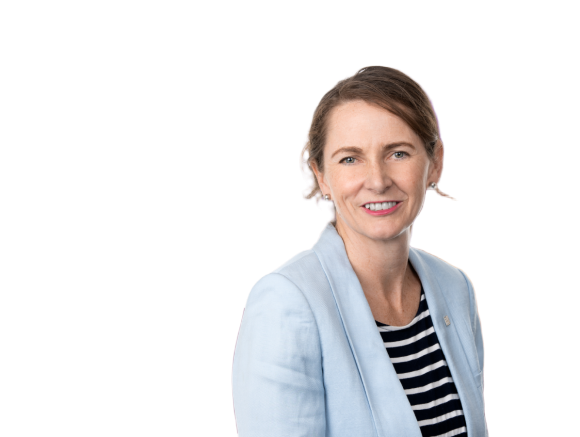
Kirsty Kelly
Chief Executive Officer | Transport Professionals Association




"Transport is an essential part of daily life, but to get the best outcomes for society we need to integrate transport and land use planning. While this can be challenging, as a career it provides the opportunity to be involved in something that is important and meaningful to people’s lives, the functioning of the economy, and the protection of our environment."
Current Positions
- Chief Executive Officer, Transport Professionals Association (formerly AITPM)
- Advisory Panel member, Urban Futures Brisbane, Brisbane City Council
Previous Positions
- Board Member, Queensland Reconstruction Authority
- Managing Director, Kirsty Kelly Consulting
- Chief Executive Officer, Illuminating Engineering Society of Australia and New Zealand
- Chief Executive Officer, Planning Institute of Australia
- Deputy Presiding Member, Development Assessment Panel, City of Marion
- Chair, Resilience Taskgroup, Australian Sustainable Built Environment Council (ASBEC)
Career Snapshot
Kirsty Kelly is the Chief Executive Officer of Transport Professionals Association (TPA) and is an experienced leader in the built environment sector, having previously served as CEO of the Planning Institute of Australia and IES: The Lighting Society. Starting her career as an urban and regional planner, Kirsty has worked as a planner across local, state and territory government, the private sector, academia, and non-profit associations.
During her career, she has collaborated extensively with leaders, governments, industry, and professionals across the country to bring about positive change and transformation in the built environment to benefit communities. She has a strong focus on the integration of transport and land use planning and active travel.
Kirsty is also an experienced Director, with previous roles on boards including the Queensland Reconstruction Authority, the Australasian Society of Association Executives and the Planning Institute of Australia. Kirsty was elevated to Fellow of the Planning Institute of Australia in 2017.

In her own words
Transport is an essential part of daily life, but to get the best outcomes for today’s society for tomorrow’s communities we need to work together to better integrate transport and land use planning. While this can be challenging, as a career it presents exciting and extensive opportunities to be involved in something that is important and meaningful to people’s lives, the functioning of the economy, and the protection of our environment.
TPA proudly represents people working across all facets of transport, including transport planners, engineers, modellers, network operators, planning and policy professionals and economists, as well as people working in road safety, traffic management, freight professionals, and travel demand management. It’s a broad constituency, and we are very much focused on connecting and sharing knowledge across the industry. Our members are not just involved in built infrastructure, but also in programs and policies that influence how people travel, which ties into our motto Shaping Every Journey.
I started as CEO of TPA just before COVID, and pre-COVID it was largely a state based, in-person association, with after-work technical events and networking, which was quite limiting in terms of who the audience could be. Around that time women represented 25% of our membership, although there were higher proportions of women coming through in the younger cohort as part of a generational shift.
While transport certainly has a technical component, it’s also about people and their behavioural decisions, which is an area where we do see more participation from women, particularly in the travel demand management and transport planning sector where we have dedicated increased focus in our content.
This focus - combined with a stronger emphasis on digital events that are also timed to better align with family schedules, and organisational memberships that unlock engagement from new participants - has led to a significant rise in the share of women in TPA from 25% to 33%; a growing share of a total membership that between 2020 and 2026 rose from approximately 900 to 3,700.
The generational shift for younger women entering the sector continues. Even though 20% of the most senior or late-career members are women, 40% of our emerging professionals are women, pointing to further diversity in the future.
It is not only women who have responded positively to TPA’s efforts to become more accessible, with digital events substantially increasing participation from members in rural areas and even overseas from countries such as New Zealand. A strong part of our membership was born and trained overseas, and a large portion of the students taking part in masters’ programs in transport are international students. We are mindful of that in our presentations and our online event content is made available so that members can access to view in their own time, allowing more time to digest or for the use of a translation service for deeper comprehension for those where English is not their first language.
Building understanding
The challenge for the transport industry is the breadth of the issues to consider, at a time when resources in the industry are extremely stretched. We are increasing our professional development and seminars on these issues, and more recently have introduced upskilling initiatives like the Continuing Professional Development (CPD) program. There are currently no undergraduate degrees in Australia that are specifically dedicated to transport, and only a couple of masters programs in this field. The CPD fills in important gaps of knowledge for professionals across a broad spectrum of specialties, and our aim is to eventually expand the CPD to include an assessment and/or certification component.
My personal focus is raising awareness and knowledge of key challenges we have as a society that cause inequalities in access to opportunities through lack of transport choices – including land use planning, gender, and disability - and ensuring our members’ work is addressing these.
When we focus on gender, we need to look at the differences and challenges women face in transport both from a career perspective but also in terms of a user experience. The reality is women’s journeys are different to how we have typically considered them, even from a transport modelling perspective.
I see it as part of my role to ensure we are offering professional development and shining a light on issues that our members may have engrained biases towards that they didn’t realise – gender is only one of these issues, and inclusive mobility more broadly has been a key priority for TPA in recent years.
The way transport is designed can potentially create barriers to participation for certain groups in society. I experienced this with a mixed upbringing living in four different states, often in outer suburbs and even in caravan parks, and I realised early in life how where you live affects the opportunities you have. This motivated me to pursue the career I’ve had, and I am aware there is always more that needs to be done to tackle inequities in the sector. At TPA we seek to raise awareness of these barriers and how they can be lifted for large portions of the population.
In terms of enhancing safety, the challenge is how do have a seat at the table and get what we have been talking about for years implemented. Integrating transport and land use planning is critical so we have services and activities in the right locations and connected with routes that are safe with natural surveillance, good lighting, and sensible crossing points. There are some interesting innovations coming through in safety, with technology around surveillance and AI to monitor movements and predict incidences before they happen which can in turn inform improvements to the environments.
Other more recent TPA initiatives have seen us actively engaging in policy and advocacy, which may not be new for most organisations but it is for us. As the group that represents the professionals who plan, design, manage and operate transport systems, we need to be delivering systems that make a difference to people’s lives.
While we can upskill people from a professional development perspective, there are a range of areas where we need governments to improve. To effect change, we need to take positions. Our Decarbonising Transport Policy Issue Paper, developed in 2024, was our first step into that policy space. Since then, we’ve been looking at how to best utilise the expertise of our members to advocate to governments and industry around the changes needed for transport policy.
As a result, we’re certainly seeing some changes at a local government level, but also in some states and territories around active transport. One aspect of the decarbonising transport effort was mode-shift: encouraging greater use of active transport and public transport. We met with key decision-makers at federal and state levels to discuss how we address carbon in the transport system, and a number of state initiatives announced since have acknowledged our work.
The give-back
My advice to people coming into the industry is to back yourself and know that sometimes when you are in a room of people you perceive to be more experienced, expert, and important than you, it doesn’t mean your knowledge and life experience isn’t worthy. Don’t be afraid to ask questions, because often the question you’ve got is what everyone else around the table is thinking but not willing to say.
I had leadership opportunities in my career quite young, which built upon my volunteer leadership roles. I was 34 when I became Chief Executive of the Planning Institute Australia, with limited business experience, but I had some good supporters and mentors. You need to build a network of people you can call on for advice but the reverse of that is you must provide that support network for others and give back. I work to ensure that I am giving an equal voice to women taking on roles in TPA. From our female members who hold senior roles themselves, we frequently hear of the impact their presence in those positions has had on both inspiring emerging leaders and making them feel more welcome.
My vision for the next five years is...
…transport is more accessible for everyone of all abilities, and we will be an industry not just focused on building more infrastructure, but supporting people to have the choice to live, connect and move in ways that are healthier for them and healthier for the environment.