

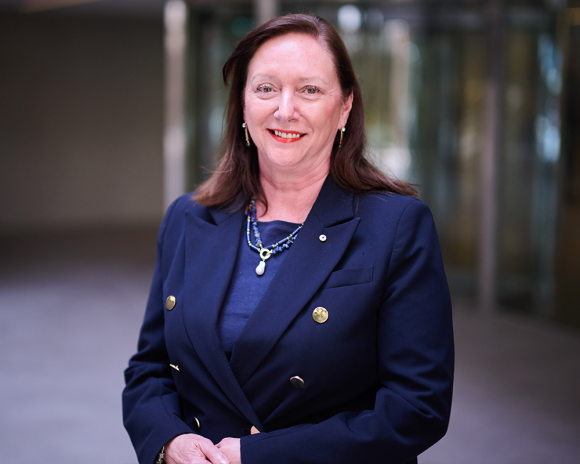
"I'll tackle the hard jobs, but I'm very inclusive. I just love working with people and through people to get things done."
Current positions
- President, Royal Aeronautical Society Australia
- Chair, Australian Logistics Council
- Non Executive Director, Sydney Airport
Previous positions
- Director, Commonwealth Superannuation Corporation
- Director, Australian Strategic Policy Institute
- Australian Government Freight Controller, Australian Government
- Northern Territory Defence and National Security Advocate, Northern Territory Government
- CEO & Managing Director, Airservices Australia
- Commander Joint Logistics Australian Defence Force, ADF
Margaret is currently the President of the Royal Aeronautical Society Australia Division where she champions innovation, professional excellence and the advancement of aerospace capability across the nation. She is the Chair of the Australian Logistics Council, helping to shape the strategic agenda for Australia’s freight and supply chain networks, as well as a Non-Executive Director at Sydney Airport, one of Australia’s most critical transport gateways.
She has previously held directorships with the Commonwealth Superannuation Corporation and the Australian Strategic Policy Institute, providing oversight across investment, policy and strategic defence matters.
In national leadership roles, Margaret was appointed Australian Government Freight Controller during the COVID-19 pandemic, safeguarding critical supply chains and ensuring the continued movement of essential goods across the country. Margaret was Chief Executive Officer and Managing Director of Airservices Australia, where she led Australia’s air navigation service provider through a period of significant operational and technological reform.
Her distinguished 30-year career in the Royal Australian Air Force culminated in her appointment as Commander Joint Logistics for the Australian Defence Force, with responsibility for integrated logistics operations across land, sea and air domains. She also served on exchange with the United States Air Force at the Pentagon, strengthening international defence cooperation.

Even though my father was in the Air Force, I originally wanted to be a primary school teacher. When I grew up, I only ever saw women in typing roles or as nurses and I knew that was definitely not my calling. I went to a school jobs fair and started chatting to the defense recruiters and they suggested I become a supply officer with the Air Force. Suddenly I thought, gosh maybe a primary school teacher might be a bit boring and that’s where it started, it wasn’t a burning ambition that I always had.
I joined the Air Force when I was 18, straight out of school and did a Bachelor of Business Studies as a cadet. I did a three-year degree with, what is now, University of South Queensland. That was the system at the time, before the military consolidated all officer education training. When I joined, women couldn’t be pilots simply because we were female. There were a lot of categories that weren’t open to women back then. It wasn’t until the 90s that women were allowed to be pilots and our first Australian lady fighter pilots graduated around 2017.
United States Exchange Program
When I started as a supply officer for Squadron 486, that squadron maintained Hercules aircraft, 707 aircraft and caribou aircraft. My job was to make sure they had all their equipment and supplies. Some time later, I was posted to the United States Air Force in an exchange position which was an amazing experience. I was in the Pentagon and I worked in the Air Force Headquarters. I was also there through September 11. While that was an extraordinary day that changed the world, I was working on a transformation program in the early days of electronic supply chains, it was the beginning of electronic purchasing and I was working with companies like Lockheed Martin, Boeing and General Electric. I learned a lot and got to meet a lot of very senior industry people in the defence industry. Being part of that program set me up for a number of other transformation programs that I’ve been in, or led subsequently, and I was awarded the United States Meritorious Service Medal for the work I did there.
Set up for strong leadership
When I finished in the permanent Air Force, I was at the rank of Air Vice Marshal, the most senior woman in the Australian Defence Force. I’d reached that level from being a Commander in charge of the Joint Logistics Command where I was managing contracts with the Middle East. I had a budget of $1.4billion and around 4,000 people working for me with business units all around the country. Later, I was also CEO and Managing Director at Air Services Australia for a few years and Director of Commonwealth Super for nine years.
When COVID hit, and the government closed international borders and stopped passenger flights, I was appointed by the Deputy Prime Minister as the Australian Government Freight Controller. A program was established called the International Freight Assistance Mechanism and I ran it with a civilian logistic leader. 90% of Australia’s air freight capacity was wiped out and that job which was originally planned to be three months, ended up being two years.
This Australia Day 2026, I was awarded a member of the Order of Australia for service to business, and the aviation, freight and logistics industries. Now I have two AMs. I received one in 2009 in the military division, this last one is in the general division.
Critical influences
Sir Angus Houston was the Chief of Air Force when I went on that Air Force Exchange and he was instrumental in bringing me back to Air Force Headquarters in Canberra to fix logistics in the Air Force. Then I developed a transformation program for Air Force logistics, and over the years he encouraged me to stay when I was thinking about leaving and made it clear what opportunities were available for me in the senior roles.
I think having a good education is key and I am also very passionate about aviation safety. My husband was killed in an aircraft accident while I was pregnant with twins so I’ve lived through what it means when things go wrong. Aviation transport can be very unforgiving. That was an instrumental thing that happened to me, and it has influenced my approach to work and what is important.
Opportunities, people and balance
One thing I learnt when I went to Air Services was that people stereotype military officers. They expect that you’re going to yell at everyone and not listen and that’s not true. I love working with people and through people to get things done. I’ve worked hard with teams to achieve outcomes that have been quite transformative. For me, success is about integrity, authenticity and honesty.
Organisational change management is about working with people. When you’re trying to drive change, you’ve got to work really hard with people to help them understand why they have to change and how.
People sometimes ask me, so you joined the Air Force, you must have had a plan to get to Air Vice Marshal. But I didn’t. I didn’t even conceive that it was possible. I would say work hard, have a strong work ethic and be open to opportunities. It was a big thing for me to go to the United States, but if I hadn’t been open to that opportunity I wouldn’t have developed so much, and my children loved school over there. Look after yourself and maintain balance, sometimes we forget to do that.
To continue contributing to Australia’s transport and logistic resilience. Building our national resilience, national security and bringing government sectors together for the good of the nation.